
Morning routine for kids before school: an example, a picture chart, and getting out the door on time
Photo: Laura Chouette / Unsplash
A morning routine for kids works best when it is short, in the same order every day, and shown in pictures: wake up, get dressed, breakfast, brush teeth, shoes on, bag. Time each step once, add a cushion of spare minutes, and count back from the moment you need to be out the door. That gives you the wake-up time, and it turns "hurry up" into a plan your child can see.
An example morning, timed
Every family's morning is different; this is one example for a child of about 5 who has to leave at 8:15. The step lengths are the kind you'd measure by timing an ordinary morning, not targets.
| Step | Example time | Tip |
|---|---|---|
| Wake up | 2 min | Same wake-up time on school days. |
| Get dressed | 6 min | Clothes laid out the night before; 2 or 3 to choose from at most. |
| Breakfast | 12 min | The longest step; start it on time and the rest follows. |
| Brush teeth | 3 min | 2 minutes of brushing, plus getting there. |
| Shoes on | 3 min | Shoes and coat in the same spot every day. |
| Backpack | 2 min | Packed the night before; this step is just picking it up. |
| Total | 28 min | Plus a cushion: here 10 minutes. |
Two of these steps have numbers from health sources behind them. Breakfast: the American Academy of Pediatrics notes that studies show eating breakfast positively affects school performance. Teeth: brush twice a day for 2 minutes, and children need help with brushing until about 8 years old (the NHS says most children can brush on their own from about 7).

Count back from the leaving time
Most rushed mornings aren't slow children; they're mornings that started too late for the steps in them. Add up the steps, add a cushion for the shoe that's gone missing, and subtract from the leaving time:
Leaving time 8:15 − steps 28 min − cushion 10 min = start at 7:37.
If 7:37 is earlier than your child wakes now, either move the wake-up time or take something out of the morning (pack the bag and lay out clothes the night before). Don't squeeze the cushion to zero: that is the step that absorbs a spilled drink.
Make it a picture chart
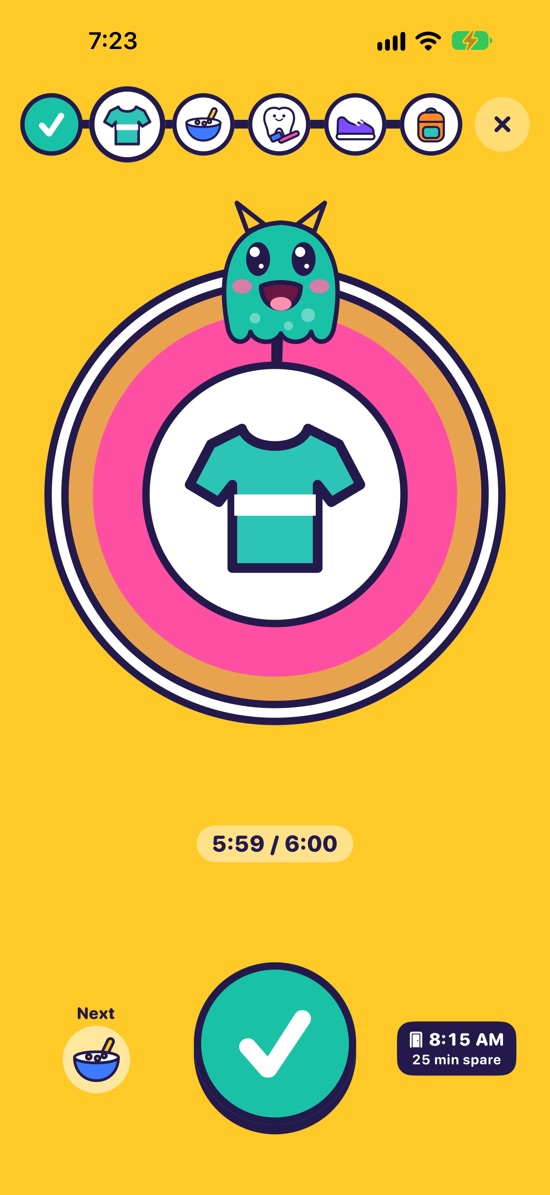
A morning routine chart for kids is just the list above with a picture for each step, in order, where your child can see it. Children who can't read yet can still follow pictures, and a chart answers "what now?" without you having to.
- One picture per step, in the order you do them. Six steps is plenty for a young child; CDC notes that with a toddler's or preschooler's short attention span, longer routines might be a challenge.
- Tick off what's done. A finished step that visibly disappears or gets a tick is satisfying, and shows how much is left.
- Keep it predictable. CDC's parenting guidance: routines and rules help kids feel safe and know what to expect; keep them simple and fun, and explain changes calmly.
- Praise the steps, not just the finish. CDC suggests praising the behaviour you want each time you see it.
What a 3, 4 or 5 year old can do alone
A routine that asks for things a child can't do yet will fail every morning. CDC's developmental milestones give a feel for what most children manage:
| By age | Milestone (CDC) |
|---|---|
| 3 years | Puts on some clothes by himself, like loose pants or a jacket. Uses a fork. |
| 4 years | Unbuttons some buttons. Serves herself food or pours water, with adult supervision. |
| 5 years | Buttons some buttons. Does simple chores at home, like matching socks or clearing the table after eating. |
So at 3, "get dressed" may mean "put on your trousers and jacket while I do the rest"; by 5 it can be most of the job. CDC's tip for 4 year olds also helps in the morning: let your child choose what to wear, but limit the choices to 2 or 3.
Getting out the door without yelling
- One direction at a time. CDC recommends giving one direction at a time, simple and clear. "Shoes on" works; "shoes, coat, bag and where's your water bottle" doesn't.
- Let the time be visible. "We're late" is abstract to a 4 year old. A timer that shows time running out lets your child see it for themselves, and you stop being the clock.
- Get the night before to do half the work. Clothes laid out, bag packed, shoes by the door.
- Keep the cushion. Ten spare minutes on the plan turn a lost shoe into an inconvenience instead of a crisis.
- Say what went well. "You were ready before the timer ran out" is worth more than another reminder tomorrow.
This guide is general information for parents and carers, not medical advice. Every child develops at their own pace; if you have concerns about your child's development, talk to your child's doctor.
- CDC: Tips for Relying on Routines and Rules (Essentials for Parenting Toddlers and Preschoolers)
- CDC: Tips for Giving Directions
- CDC: Milestones by 3 Years, 4 Years, 5 Years
- HealthyChildren.org (AAP): Breakfast for Learning: Why the Morning Meal Matters
- HealthyChildren.org (AAP): Toothbrushing Tips for Young Children
- NHS: Children's teeth
All sources checked 20 November 2026.